
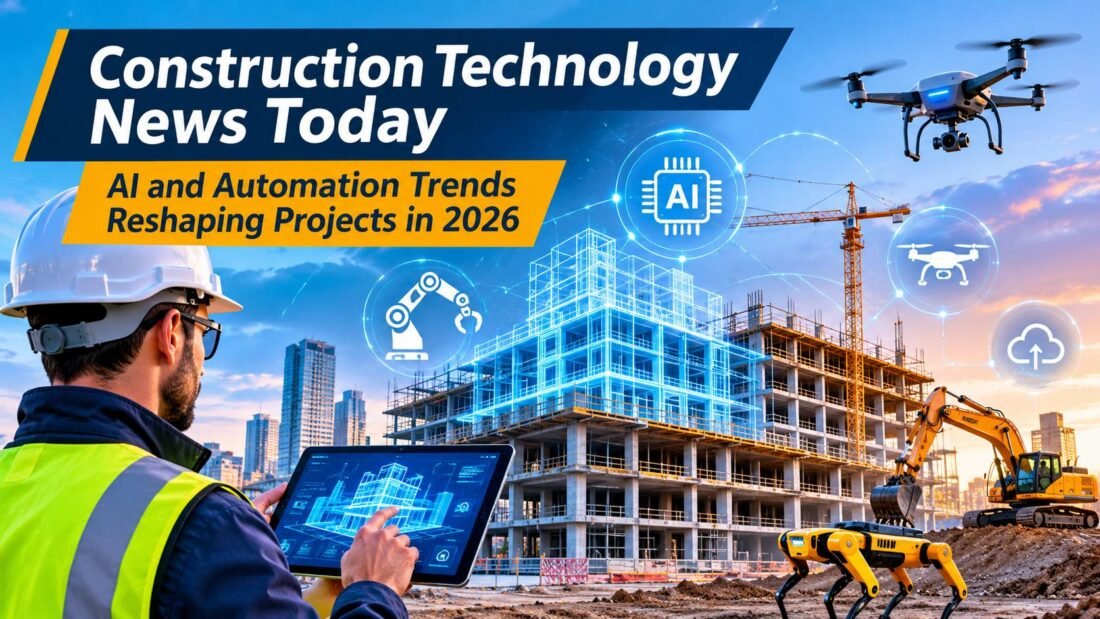
Most of the construction technology news today comes down to one question: which tools are actually changing how projects get built, and which are still demos?
Three areas have moved past the pilot stage in 2026: AI agents inside project management software, autonomous heavy equipment, and AI-driven site monitoring.
This article covers what has happened in each, what the numbers say, and how a contractor, owner or project manager can decide where to start.
Where the Industry Stands Right Now
Construction has a long record of lagging other sectors on productivity. A McKinsey analysis reported by Construction Dive found that global construction productivity improved only 10% between 2000 and 2022. That context explains why the current wave of AI investment gets so much attention, and why skepticism is reasonable.
McKinsey’s July 2026 report, “How AI is reshaping the future of the AEC industry,” puts some numbers on the opportunity. It estimates that AI could automate 39% of nonphysical work in construction, compared with 50% in architecture and engineering. The firm mapped 150 workflows across 25 AEC-related domains and expects data entry, invoicing and equipment inspection to change the most by 2030.
The report also separates tasks from jobs. An estimate of work that could be automated is not a forecast of roles disappearing, and a McKinsey partner quoted in the coverage made the same point: only certain roles can be automated, and the real gains come from how activities are connected across the project life cycle.
AI Agents Are Moving Into Project Management Software
The most visible change this year is the shift from AI chat assistants to AI agents that act inside the software contractors already use.
Procore is the clearest example. In May it introduced agents built on embedded Datagrid technology, aimed at executing construction workflows in real time through Actions and Triggers rather than simply answering questions.
By July the company had expanded its library to 20 AI agents built for specific construction workflows and launched packaged tiers (Starter, Pro and Enterprise) under the name Digital Coworker. The agents cover work like RFI analysis, submittal cross-checking, daily logs and contract review. An upcoming feature called Skills is meant to let firms teach the agents their own standards and procedures.
Autodesk and Trimble are pursuing similar goals from different starting points. Both have been investing in AI, and both have talked publicly about the same obstacle: adoption on the jobsite. Autodesk’s head of architecture, engineering and construction has said that getting workers to use AI instead of habits like pen and paper remains a challenge.
A Trimble executive made a related point, noting that using AI forces firms to create the structured data the technology needs later. A practical example: a general contractor with 40 open RFIs and a stack of submittals can have an agent draft responses, flag conflicts against the specs and route items to the right reviewer.
A person still approves the output. One figure that has circulated is a target of cutting RFI and submittal review time by 50%, attributed to a Buro Happold executive. Treat that as a goal rather than a benchmark, since results depend on how clean a firm’s documents and project data are.
Autonomous Equipment Has Started Doing Paid Work
Robotics in construction has produced plenty of announcements over the years. What stands out in the latest construction technology news is that autonomous machines are now working on commercial sites.
On October 26, Bedrock Robotics announced a $600 million Series C co-led by CapitalG and Emergence Capital, valuing the company at $4.1 billion and bringing total funding to nearly $1 billion. The company retrofits existing heavy equipment with its autonomy system, starting with excavators. Its machines began paid autonomous work at commercial construction sites in August.
According to TechCrunch, excavators with Bedrock’s technology are operating commercially at a Nevada water treatment facility, a Texas earthwork site run by Champion Site Prep, and a 1.2 million cubic yard civil project with Zachry Construction Corporation. Bedrock says it focused on excavators partly because of the operator shortage, noting that it takes five years or more to master excavator operation.
Some caution is appropriate. Funding rounds show investor confidence, not proven economics. Revenue and fleet figures have not been disclosed, so contractors evaluating autonomous equipment should ask for site-level data on productivity, downtime and safety before committing.
Site Monitoring and Analytics Are Getting Smarter
A quieter trend is the use of cameras, drones and AI analysis to compare what is built against what was planned. Buildots recently launched an Intelligence Lab, which it describes as an AI-powered hub for construction project data research.
Reports from mid-2026 also say Procore agreed to acquire DroneDeploy for roughly $845 million in cash, which, if completed, would tie aerial capture directly to a major project management platform.
The appeal is catching problems early. A missed framing inspection or a misplaced penetration found in week two costs far less than the same issue found at closeout. Industry attention is also high: Chicago Build, held October 28 and 29 at McCormick Place, expected more than 30,000 construction and design professionals and included a dedicated AI and digital construction zone.
What This Means for the Labor Shortage
Automation is often framed as a way to ease labor pressure rather than replace workers. As of January 2026, Associated Builders and Contractors data showed that the construction sector was short about 349,000 workers. Agents that handle paperwork free up project managers and superintendents, and autonomous equipment targets the skills that take years to build.
Technology does not remove the need to find and keep good people, though. Trade professionals still rely on referrals and relationships, and digital networking is part of that. For a look at how one market handles it, see this overview of Construction Networking in the UK, which shows how platforms are being used to connect tradespeople with contractors outside the U.S.
Comparing the Main Trends
| Trend | Example companies | What it automates | Best fit | Main watch-out |
|---|---|---|---|---|
| AI agents in project software | Procore, Autodesk, Trimble | RFIs, submittals, daily logs, contract review | Mid-size and large contractors already on a platform | Quality of existing project data |
| Autonomous equipment | Bedrock Robotics | Excavation and earthmoving | Civil and sitework contractors | Limited public performance data |
| Site capture and analytics | Buildots, DroneDeploy | Progress tracking, as-built comparison | Projects with frequent inspections | Setup time and crew buy-in |
| Custom in-house AI | Suffolk, Turner | Firm-specific workflows | Large firms with proprietary data | Cost of building and maintaining |
How to Decide What to Adopt First
McKinsey’s report offers a useful frame. It recommends prioritizing three to five high-value workflows, choosing where to buy, build or partner, scaling with governance, and measuring what matters. Translated for a typical contractor:
- Start where paperwork piles up. Look at RFIs, submittals, daily reports and invoicing. These are repetitive, data-heavy and low risk if a person reviews the output.
- Check your data first. Agents work from what you give them. If drawings, specs and change orders live in scattered folders, fix that before buying anything.
- Buy before you build. The report notes that AEC firms have historically struggled to build and scale software, and that AI is advancing too quickly for most to rely mainly on internal development. Large builders like Suffolk and Turner are experimenting with in-house tools, but they have the data and staff to do it.
- Run a limited pilot with a measurable target. One project, one workflow, and a number to compare against, such as average RFI turnaround time.
- Ask vendors hard questions. Request customer references at a similar size, details on how your data is used, and what happens when the AI is wrong.
Risks Worth Taking Seriously
Adoption is only part of the story. Cybersecurity is a growing concern as more project data moves through AI systems, and a recent Construction Dive column noted that contractors rank cybersecurity low on their priority lists, while lawyers stress that preparation matters when a breach occurs.
Trust is another problem. If field crews see a tool as extra work, they will skip it, and the data it depends on will stay incomplete.
The Takeaway
The most useful reading of the latest construction technology news is that value is concentrated in a few places: administrative workflows, repetitive heavy equipment tasks and early problem detection on site.
Pick one workflow that costs your team real hours each week, test one tool against a clear metric, and expand only when the numbers hold up. Waiting for the technology to become perfect is a risk too, since McKinsey expects early productivity advantages to become table stakes before long.
Published by CitedX.
Frequently Asked Questions
What is the latest construction technology news today?
AI agents in project software, autonomous excavators doing paid work, and AI site monitoring are the biggest construction technology developments of 2026.
How is AI used in construction projects?
AI drafts RFI responses, checks submittals, writes daily logs, reviews contracts and compares site images to plans. People still approve the results.
What are AI agents in construction?
They are tools inside platforms like Procore that complete tasks such as RFI analysis or daily logs, rather than only answering questions.
Are autonomous excavators being used on real job sites?
Yes. Bedrock Robotics says its autonomous excavators began paid work on commercial sites in August 2026, including a Nevada water treatment facility.
Will AI replace construction workers?
McKinsey estimates AI could automate 39% of nonphysical construction work, but it targets tasks rather than whole roles, so people stay involved.
Which construction tasks should be automated first?
Start with repetitive paperwork such as RFIs, submittals, daily reports and invoicing, where a person can review the output before it is used.
How do I choose a construction AI tool?
Check your data quality first, ask for references from similar-size firms, confirm how your data is used, and pilot one workflow with a measurable goal.
Should contractors build or buy construction AI?
Most should buy. McKinsey says AEC firms have struggled to build software, so build only where your own data or expertise is the advantage.
What are the risks of using AI in construction?
Main risks include poor project data, low crew adoption, unverified vendor claims and cybersecurity, which many contractors rank low in priority.
Can construction technology help with the labor shortage?
It can help. Agents reduce admin work and autonomous equipment targets hard-to-fill skills, but firms still need to recruit and retain skilled workers.